.png)

The Forgotten Foundation
When a floor fails prematurely — blistering, peeling, or delaminating — the cause is rarely the coating itself. More often, it’s inadequate mechanical preparation.
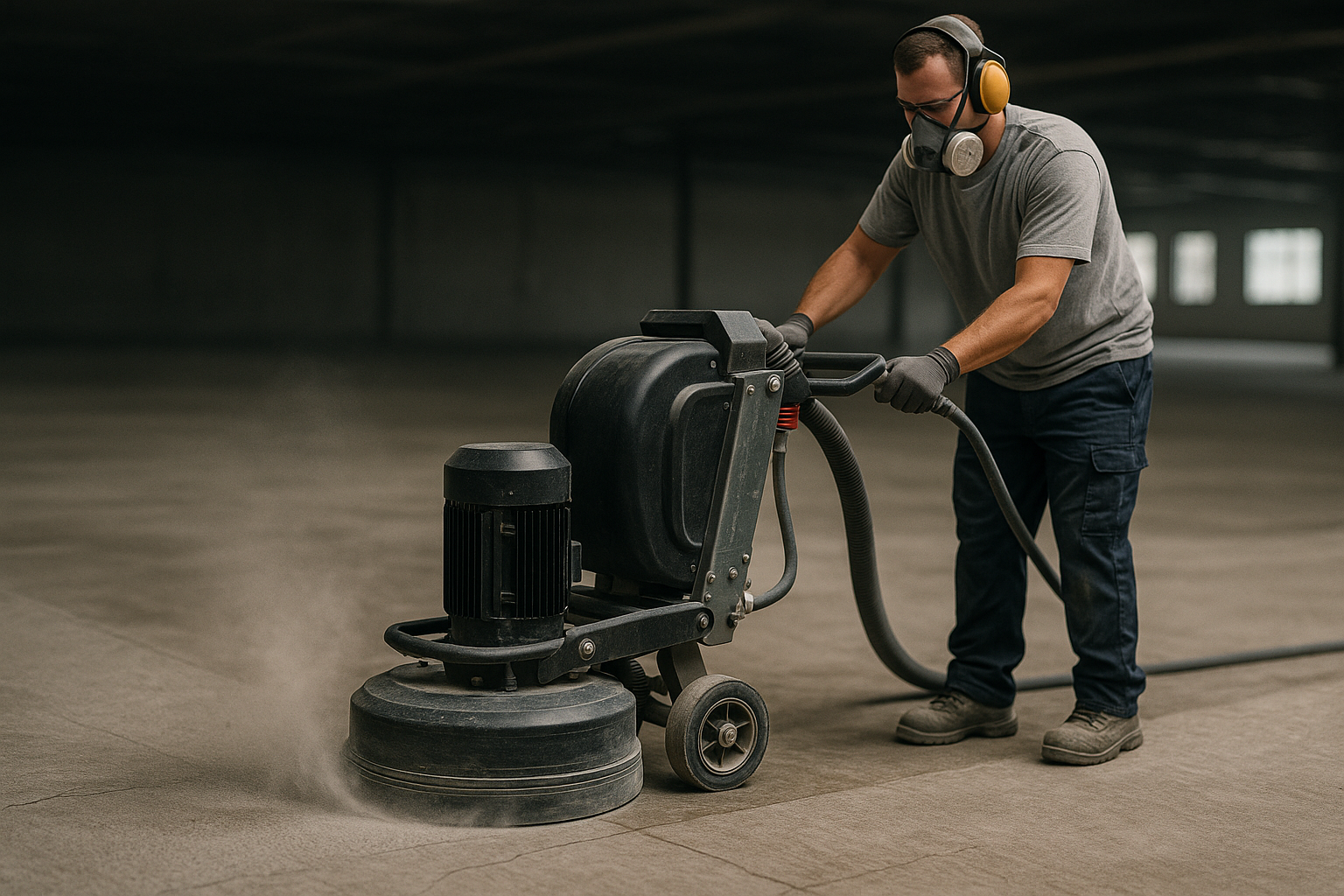
Concrete surfaces must be ground, shot-blasted, or scarified to create the correct Concrete Surface Profile (CSP), ensuring strong adhesion between the floor system and the substrate.
What Is a Concrete Surface Profile (CSP)?
The CSP measures surface roughness and texture. It ranges from CSP 1 (nearly smooth) to CSP 10 (very rough), and each system requires a specific profile for optimal performance:
- Polished Concrete: CSP 1–2
- Thin Epoxy Coating: CSP 2–3
- High-Build Epoxy or Urethane Systems: CSP 3–5
- Urethane Cement or Broadcast Systems: CSP 5–7
Choosing the wrong profile can lead to adhesion failure, uneven gloss, or premature wear.
Why Surface Prep Matters
Proper surface preparation does three critical things:
- Removes Contaminants
Oils, adhesives, or sealers can interfere with bonding. Grinding exposes clean concrete. - Opens the Surface
Creates microtexture for coatings to anchor into mechanically. - Levels Imperfections
Eliminates high and low spots that impact both function and appearance.
The Science Behind Adhesion
Epoxy and resin systems rely on two forms of adhesion:
- Mechanical Bonding: The coating grips the rough surface like Velcro.
- Chemical Bonding: The resin interacts with the surface layer.
Without the correct CSP, both mechanisms are compromised. A too-smooth surface offers nothing for the coating to bite into, while an overly rough one wastes material and can trap air.
Tools and Techniques for Preparation
- Diamond Grinding: Creates a uniform profile ideal for thin coatings or polish systems.
- Shot Blasting: Uses steel shot to clean and texture simultaneously; great for heavy-duty applications.
- Scarifying: Removes high spots and thick residues quickly for deep prep work.
- Dust Control Systems: Essential to maintain air quality and surface cleanliness.
Surface Solutions uses state-of-the-art machinery and HEPA filtration to ensure both precision and compliance.
Case Study: Retail Renovation with Profile Correction
A national retailer hired Surface Solutions to recoat a 12,000 sq. ft. epoxy floor. The previous contractor had applied the coating directly over sealed concrete. Within months, it was peeling.
We removed the failed layer, ground to CSP 3, and installed a high-build epoxy system with proper mechanical bonding. Two years later, the floor still looks brand new.
The Cost of Skipping Prep
When contractors skip or rush prep, they risk:
- Delamination within months
- Uneven gloss in polished concrete
- Shortened system lifespan
- Costly warranty voids
Every hour spent on surface prep can save thousands in rework.
Surface Solutions’ Approach to Preparation
- Assessment – Evaluate concrete condition, hardness, and contamination.
- Profiling – Achieve specified CSP using the appropriate technique.
- Moisture and pH Testing – Identify hidden risks before installation.
- Verification – Measure texture and cleanliness before proceeding.
We document every step so clients know their floor meets manufacturer and industry standards.
The Bottom Line
A floor’s performance depends on what lies beneath the finish. Proper surface preparation is not optional — it’s the difference between a floor that lasts a decade and one that fails in a year.
📞 Call 877-CSTM-FLR
📧 Email carolina@cstmflr.com 🌐 Visit www.cstmflr.com