.png)

The Problem with Traditional Inspections
Historically, concrete inspection has relied on manual testing and visual judgment. While experienced eyes remain invaluable, human error and inconsistent measurement have long created gaps in data and quality assurance.
Some of the limitations include:
- Manual readings vary between technicians.
- Data isn’t centralized or easily shared.
- Environmental factors aren’t logged in real time.
- Lack of transparency for clients and architects.
In an industry where precision and documentation matter, “close enough” isn’t good enough anymore.
The Rise of Digital Flooring QA
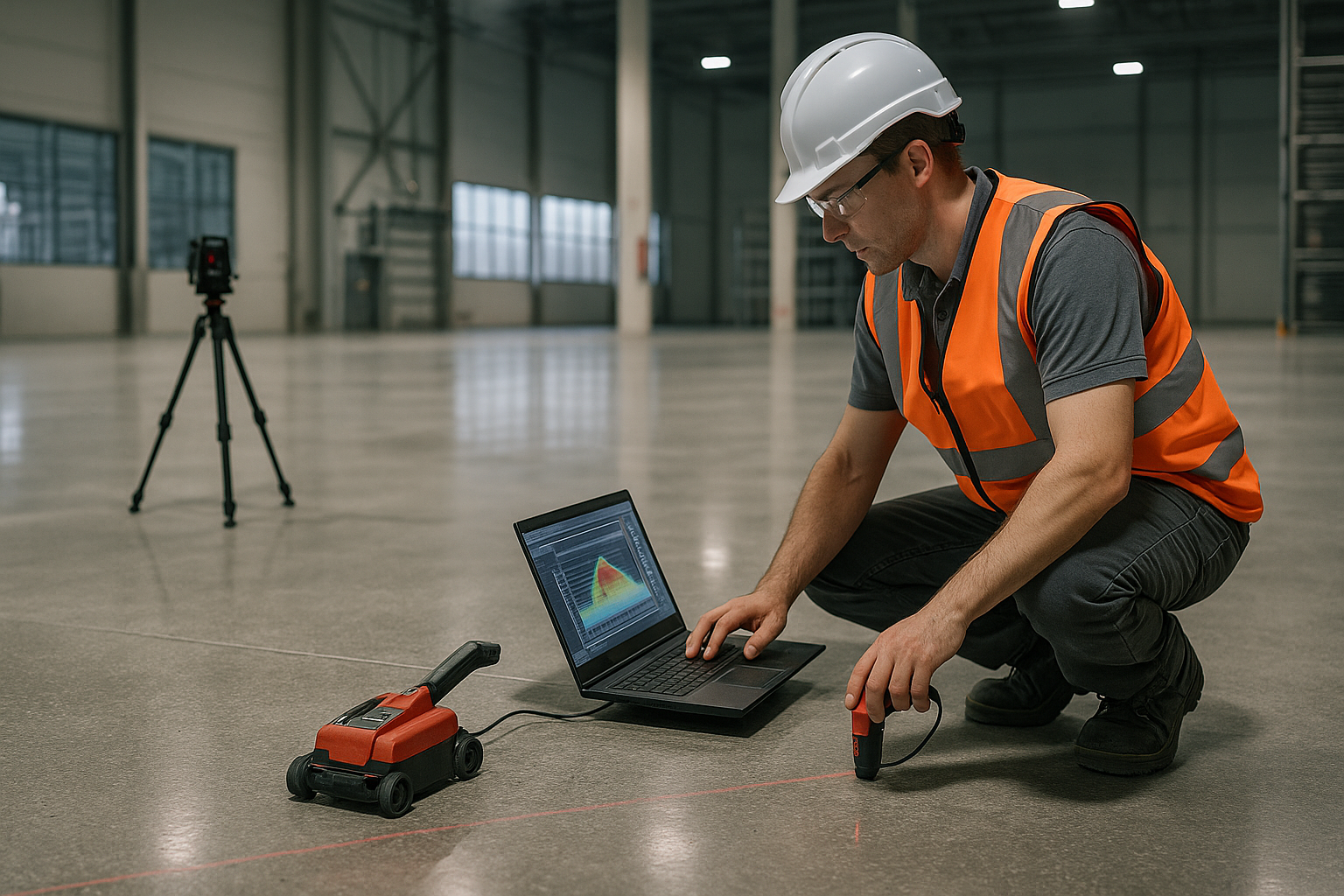
Digital quality control leverages advanced tools and software to collect objective, measurable data about slab conditions, coatings, and environmental factors.
Examples include:
- Laser flatness scanners (FF/FL Testing) – Measure floor levelness to millimeter accuracy.
- In-situ humidity sensors (ASTM F2170) – Provide continuous vapor and RH readings.
- Thermal cameras – Detect curing inconsistencies and insulation gaps.
- Digital gloss meters – Quantify polish levels and finish uniformity.
- 3D imaging and mapping – Create digital twins of finished slabs for documentation.
These systems replace guesswork with data-driven validation.
Benefits of Smart QA for Clients
- Transparency
Digital data and reports provide proof of compliance with project specifications and manufacturer warranties. - Consistency Across Projects
Multiple crews and facilities can adhere to the same benchmarks, reducing variability. - Faster Issue Detection
Real-time alerts identify problems like moisture spikes or uneven curing before they escalate. - Long-Term Performance Tracking
Archived QA data allows clients to compare results over time and plan maintenance. - ESG and Compliance Reporting
Objective inspection data supports sustainability and governance metrics for corporate reporting.
How Surface Solutions Implements Smart QC
Our process integrates advanced tools at each stage:
- Before Installation:
- RH sensors and pH testing confirm environmental readiness.
- Slab flatness mapping ensures substrate prep meets CSP requirements.
- RH sensors and pH testing confirm environmental readiness.
- During Application:
- Digital thermometers and moisture meters track ambient conditions.
- Real-time recording of cure times and product batch logs.
- Digital thermometers and moisture meters track ambient conditions.
- After Completion:
- Gloss and traction readings document finish quality.
- Drone or camera capture for final inspection and archiving.
- Gloss and traction readings document finish quality.
Each project concludes with a digital QA report — timestamped, photo-documented, and stored for the client’s records.
The Future of Flooring QA
Emerging tools like IoT-embedded sensors and AI surface mapping will soon provide continuous condition monitoring, enabling predictive maintenance.
Instead of reacting to cracks, wear, or delamination, facilities will anticipate them.
In the future, digital QA will move from a documentation tool to an active performance management system.
Why It Matters
For contractors, architects, and facility managers, technology isn’t replacing craftsmanship — it’s enhancing accountability.
Digital quality control ensures that what’s promised on paper is what’s delivered in reality.
At Surface Solutions, we’re not just installing floors. We’re building a transparent, measurable, and future-ready foundation for quality.
📞 Call 877-CSTM-FLR
📧 Email carolina@cstmflr.com
🌐 Visit www.cstmflr.com